Gypsy Feast: Recipes and Culinary Traditions of the Romany People by Carol Wilson
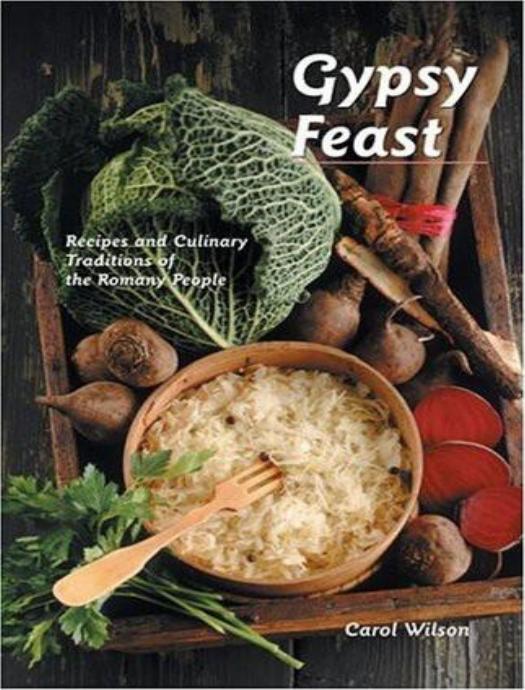
Author:Carol Wilson
Language: eng
Format: mobi, epub, pdf
Publisher: IB Dave's Library
Published: 2004-03-31T07:00:00+00:00
BIRTH
Nane chave, nane bacht
(if there are no children, it is bad luck)
Childlessness was regarded as a great misfortune, as family had an important role in the life of the Roma and was consolidated by the number of children horn. The more children, the greater the family's luck would be. The number of boys also improved the standing of the family, or as the Romany proverb says, 0 chave hin zorr-"In boys is strength." For their firstborn, the young couple would wish for a boy. Each additional child was warmly welcomed.
Pregnant women ate oatmeal jelly (jello) and also fed this to their children as it was believed to build strong healthy hones and muscles-a belief that has since been proven correct. Oatmeal is easy to digest and was also recommended to strengthen the nerves. Oatmeal jelly was a smooth gruel that set to a jellylike (jello) consistency when cold.
There was a legend among the Roma that when an old Romany musician was going to die, he or she should sing or play to a pregnant woman. Then, when the child was horn, it would inherit the musical gifts. One rite practiced by some Roma involved the untying of certain knots (so that the umbilical cord would not he knotted), including all the knots in the expectant mother's clothing. At other times, the expectant mother's hair was loosened if it was pinned or tied with a ribbon.
For several weeks before and after the birth of a child, the expectant mother was mochardi-unclean in the Biblical sense. During this time, she was isolated from the community and mostly looked after by women; she had her own set of crockery and dishes and wasn't allowed to prepare food for others. It was usual to erect a special tent for the birth, which was destroyed a month or so after the child was horn. In Hungary, when a mother began to suffer the pangs of childbirth, a fire was lit before her tent and kept up until the infant was baptized, in order to drive away evil spirits.
The quarantine period lasted from two weeks to two months, after which the tent and everything in it was burned. The father wasn't allowed to touch his child until after the baptism because the newborn child was considered impure until he or she was baptized, in the Roma way of baptism.
There are rituals (which vary according to tribe) involving the formal recognition of the infant by its father. In some cases, the child is wrapped in swaddling on which a few drops of paternal blood are placed. Other rituals involve the child being covered by a piece of clothing that belongs to the father. In some tribes, the mother puts the infant on the ground and the father picks up the infant and places a red string around its neck, thereby acknowledging that the child is his (Patrin Journal, 1999).
After giving birth the new mother breastfed her child and avoided certain foods such as pickles, tomatoes and green vegetables such as cabbage, while breastfeeding, so the baby wouldn't suffer from colic.
Download
Gypsy Feast: Recipes and Culinary Traditions of the Romany People by Carol Wilson.epub
Gypsy Feast: Recipes and Culinary Traditions of the Romany People by Carol Wilson.pdf
This site does not store any files on its server. We only index and link to content provided by other sites. Please contact the content providers to delete copyright contents if any and email us, we'll remove relevant links or contents immediately.
Biscuits: A Savor the South Cookbook by Belinda Ellis(4328)
The French Women Don't Get Fat Cookbook by Mireille Guiliano(3651)
A Jewish Baker's Pastry Secrets: Recipes from a New York Baking Legend for Strudel, Stollen, Danishes, Puff Pastry, and More by George Greenstein(3585)
Ottolenghi Simple by Yotam Ottolenghi(3581)
Better Homes and Gardens New Cookbook by Better Homes & Gardens(3580)
Al Roker's Hassle-Free Holiday Cookbook by Al Roker(3521)
Trullo by Tim Siadatan(3422)
Bake with Anna Olson by Anna Olson(3397)
Hot Thai Kitchen by Pailin Chongchitnant(3377)
Panini by Carlo Middione(3330)
Nigella Bites (Nigella Collection) by Nigella Lawson(3225)
Momofuku by David Chang(3183)
Salt, Fat, Acid, Heat: Mastering the Elements of Good Cooking by Nosrat Samin(3138)
Modern French Pastry: Innovative Techniques, Tools and Design by Cheryl Wakerhauser(3135)
Classic by Mary Berry(3009)
Best of Jane Grigson by Jane Grigson(2994)
Tapas Revolution by Omar Allibhoy(2976)
Solo Food by Janneke Vreugdenhil(2966)
Ottolenghi - The Cookbook by Yotam Ottolenghi(2928)
